

Introduction: The Enigma of Donna Tartt
Donna Tartt has published just three novels in more than thirty years. Yet each one became a massive literary event. Readers around the world eagerly wait for her next book, even when it takes ten years to arrive.

How does an author with such a small collection build such a big reputation?
The answer lies in the depth and quality of her stories. Her debut novel, The Secret History, came out in 1992 and is still one of the most mysterious novels to read today.
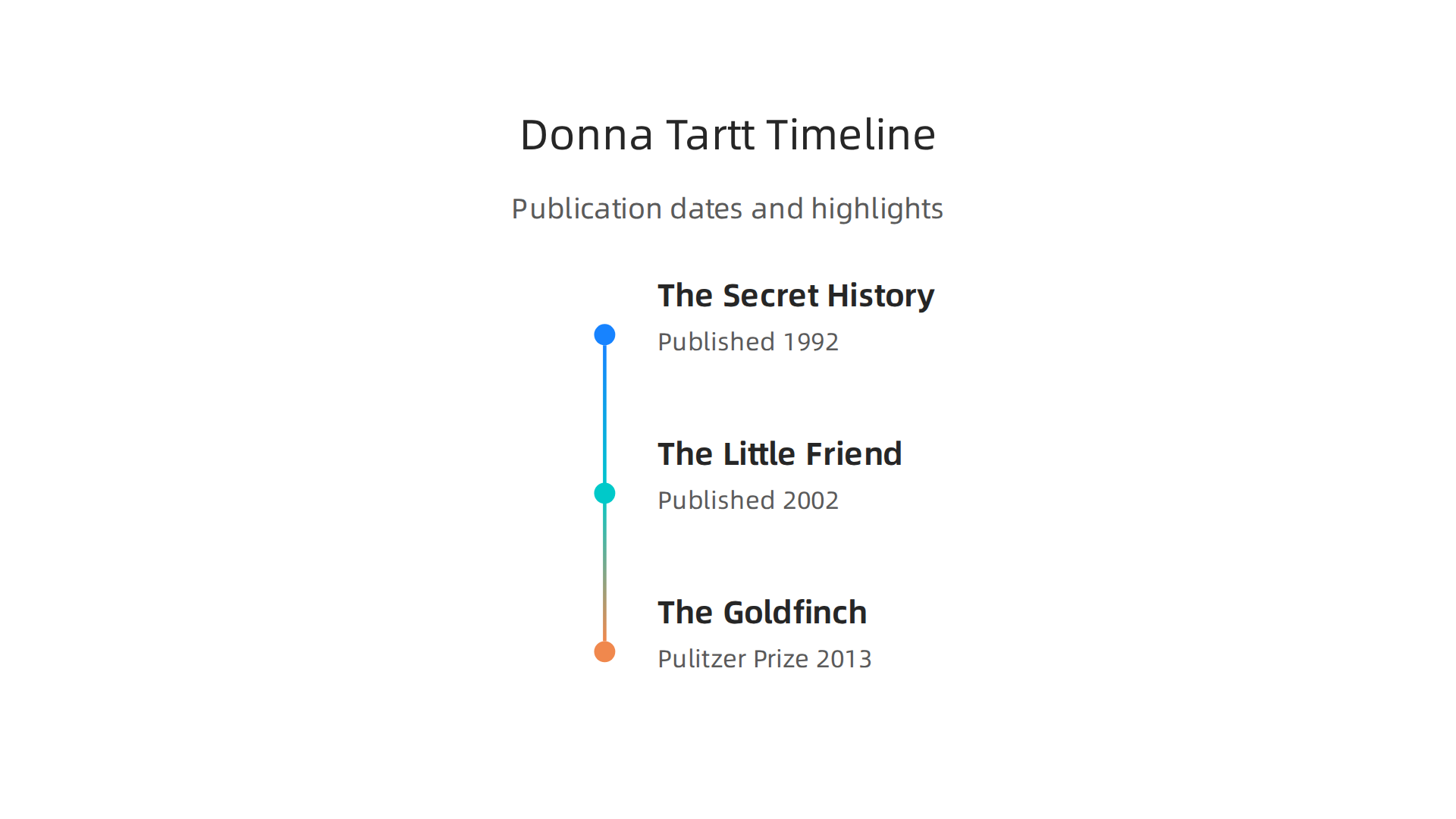
It pulls you into a world of dark secrets and college friendships gone wrong. Then came The Little Friend in 2002, and finally The Goldfinch in 2013, which won the Pulitzer Prize for Fiction. As Britannica notes, Tartt is especially known for these two books, both praised for their gripping plots and rich characters.

But if you are new to her work, the flood of opinions and reviews can feel overwhelming. You might wonder: Where do I start? What makes her style so special? And why does she write so slowly? That is the problem this guide solves.
Here, we give you a clear, friendly look at every Donna Tartt book. We explore her themes, her slow creative process, and the mystery that surrounds her. By the end, you will know exactly which book to pick up first and why her stories stay with you for years.
If you enjoy carefully crafted literary fiction, you might also like our guide to the Michael Chabon novels ranked from Pulitzer winner to genre gems. Like Tartt, Chabon weaves unforgettable stories that reward patient readers.
Now, let us uncover the world of Donna Tartt. Her books are not just mystery novels to read. They are experiences you will never forget.
Who Is Donna Tartt? Biography and Literary Reputation
You can understand a lot about Donna Tartt’s books once you know where she comes from. She was born on December 23, 1963, in Greenwood, Mississippi. That Southern setting, with its slow rhythms and deep history, shows up in the atmosphere of her stories. As Britannica notes, her Southern roots gave her a unique voice in American fiction.
Tartt discovered her love for writing early. She wrote her first poem at age five. But the big turning point came when she went to Bennington College in Vermont. There, she studied classics. This means she read Greek and Latin literature. That classical training is a huge part of what makes her novels feel so timeless and weighty. She also met other writers there, like Bret Easton Ellis, who became lifelong friends.
Now, let’s talk about the famous "Tartt mystique." You have probably heard that she is a recluse. She rarely gives interviews. And she takes forever to write a book. But here is the thing: she just values a different pace. In a rare interview, she explained, "I’ve tried to write faster and I don’t really enjoy it." For Tartt, writing is not a race. It is a deep, immersive craft.

She starts her novels by hand, scratching out words and underlining things in different colors.
This perfectionism creates huge gaps between her releases. Ten years between The Secret History and The Little Friend. Eleven years before The Goldfinch. Yet each release becomes a literary event. The Goldfinch won the Pulitzer Prize for Fiction in 2014. She has proven that you do not need to publish often to build a powerful reputation. You just need to publish work that matters.
Her reputation also comes from her themes. She writes about beauty, crime, art, and the secrets people keep. She asks big questions. In a Chatelaine interview, she talked about how culture does not always civilize us. That tension lives in every one of her books.
To understand her work better, it helps to see the full picture. If you enjoy exploring a complete literary world, you might also enjoy the timeless appeal of Frances Hodgson Burnett books. Like Tartt, Burnett creates rich settings that pull you in deeply.
Now that you know the person behind the pen, let’s open the pages of her first novel.
The Secret History: A Modern Classic and Its Enduring Mysteries
Have you ever picked up a book that felt like it was written just for you, but also left you a little unsettled? That is exactly the experience The Secret History delivers. It is the first novel from Donna Tartt, and it changed how many people think about mystery novels to read.
The story follows Richard Papen. He is a poor student who transfers to a small, elite college in Vermont. There, he gets pulled into a tight group of classics students. They are brilliant, wealthy, and obsessed with ancient Greek culture. They think they are above everyone else. Then things go very wrong. The novel famously opens by telling you the ending: Richard and his friends kill someone named Bunny. As one close reading of the prologue explains, this is “the defining moment of his life.” The whole book is a slow, tense dive into how they got there and what happens after.
So why does this book still feel so fresh? It is because of the big questions it asks. The themes in The Secret History are deep. You will find ideas about the human capacity for violence, the clash between beauty and terror, and how intellectual pride can blind you. Tartt does not give easy answers. Instead, she shows you the messy, ugly side of chasing perfection.
One reviewer called it a “hauntingly beautiful and mystical tale.” That sums it up well. The characters try to escape who they are by losing themselves in Greek tragedy, but that escape only traps them more. It is a perfect example of moral ambiguity in action. The group believes their studies make them better than others, but their arrogance leads to destruction.
For many readers, this is the best entry point into Donna Tartt books. It is shorter than The Goldfinch and has a tighter story. It also captures everything Tartt does well: rich atmosphere, complex characters, and a plot that keeps you turning pages late into the night.
If you love mysterious novels to read that make you think, this one belongs on your shelf. And if you enjoy exploring authors with a similar depth of storytelling, you might also check out our guide to Michael Chabon novels ranked. Both writers craft worlds that feel real and important.
Now, let’s move to Tartt’s second novel, The Little Friend. It takes a very different turn.
The Little Friend: A Southern Gothic Puzzle
If you thought the jump from ancient Greece to Mississippi felt like a leap, you are right. The Little Friend is a very different kind of story. It takes place in the 1970s in a small Southern town. The main character is a 12-year-old girl named Harriet. She is smart, stubborn, and carrying a heavy weight.
Here is the setup. When Harriet was a baby, her older brother Robin was found dead in the backyard on Mother’s Day. The police never solved the case. Years later, Harriet decides she will find the killer herself. She teams up with her friend Hely, and together they dive into a world of secrets and danger.
This novel is darker and more experimental than Tartt’s first book. Tartt herself called it "a frightening, scary book about children coming into contact with the world of adults in a very serious way," according to a Guardian interview from 2002. And she was not kidding. This is not a cozy mystery. It is a slow, tense, and sometimes frustrating journey.
Why This Book Divides Readers
The reception for The Little Friend was mixed. Many readers expected a thriller after the success of The Secret History. They got something else entirely. As one reviewer noted, the novel is "undeserving of poor reviews" because it was never meant to be a traditional crime story. It is about atmosphere, memory, and the slow decay of a Southern family.
One critic compared it to To Kill a Mockingbird, but that feels a bit too simple. The writing itself is rich and dense. Some readers love the way Tartt lingers on small details. Others find it frustrating. One reviewer said the writing is "amazing when it doesn’t go on forever about the smallest thing in a sort of Southern novel way." That is a fair take.
The themes in this book are heavy. You will find ideas about childhood trauma, the fragility of memory, and how the Southern aristocracy falls apart over time. Harriet is a fascinating character because she is both brave and naive. She thinks she can fix the past. But the past does not want to be fixed.
Should You Read It?
If you love mystery novels to read that challenge your expectations, give this one a try. It is not an easy read. It demands patience. But if you stick with it, you will find a story that sticks with you.
Many readers who enjoy Tartt’s style also enjoy Frances Hodgson Burnett books for their rich sense of place and complex young characters. The connection might surprise you, but both writers understand how childhood shapes everything.
The Little Friend is a strange, beautiful puzzle. It might not fit together perfectly. But the pieces themselves are worth examining.
The Goldfinch: Pulitzer Prize and Narrative Depth
If The Little Friend left you wanting more of Donna Tartt’s strange, beautiful writing, then The Goldfinch is where everything clicks into place. This novel is her biggest success. It won the Pulitzer Prize for Fiction in 2014, and it made Tartt a household name for good reason.

The story starts with a bang. A 13-year-old boy named Theo Decker survives a terrorist bombing at a New York museum. In the chaos, he steals a small painting called The Goldfinch. That one choice changes his entire life. Theo is a kid who has just lost his mother. He is alone, scared, and holding onto this painting like a lifeline.
The book follows Theo across the United States and Europe. He moves from New York to Las Vegas to Amsterdam. Along the way, he meets a colorful cast of characters. There is Hobie, the gentle antiques restorer. There is Boris, the wild Ukrainian kid who becomes his best friend. And there is the constant threat of getting caught with the painting.
What Makes This Book So Special
The Pulitzer committee called it "a beautifully written coming-of-age novel with exquisitely drawn characters," as you can see on the official Pulitzer site. And they were right. But the book is more than just a great story. It dives deep into big questions.
At its heart, The Goldfinch asks: Do we choose our own path, or are we just following chance? In a Substack reflection on the novel, the writer highlights Theo’s own words: "Why am I made the way I am? Why do I care about all the wrong things?" That line captures the whole book. Theo is a kid who never gets a break, but he also makes terrible choices. The line between fate and bad judgment blurs.
The writing itself is why Tartt fans love this book. According to Bean’s Book Blog, "at first I was mesmerized by the writing, especially the scenes depicting Theo’s relationship with his mom." Those early chapters hit hard. Tartt makes you feel the loss deep in your bones.
Themes That Stick With You
This novel touches on art, loss, and identity. The stolen painting is not just a plot device. It stands for everything Theo cannot let go of. His grief, his guilt, his hope. The book also explores the dark side of the art world. And it shows how one bad choice can set off a chain reaction.
Many readers compare Tartt’s dense, atmospheric style to the work of authors like Cormac McCarthy. If you enjoy mysterious novels to read that challenge your idea of what a story can be, The Goldfinch belongs on your shelf. It is a long book, over 700 pages, but it never feels slow. Every page matters.
A 2019 film adaptation came out, but most fans agree: the book is far better. The movie tries to cram too much into two hours. The novel gives you time to breathe.
Should You Read It?
Yes, absolutely. If you are looking for mystery novels to read that feel real and painful and beautiful all at once, pick up The Goldfinch. It is not a whodunit like The Little Friend. It is a why-dunit. Why do we hold onto the things that hurt us? Why do we run from the truth?
Among all donna tartt books, this one is the most accessible. It won awards for a reason. Read it slowly. Let the mood wash over you. And if you want another Pulitzer winner to try next, check out our guide to Michael Chabon novels ranked from Pulitzer winner to genre gems. Both writers know how to turn loss into art.
The Goldfinch is a modern classic. Do not miss it.
Recurring Themes and Motifs Across Tartt’s Oeuvre
Once you finish all three donna tartt books, something becomes clear. Donna Tartt is not just a writer who tells different stories. She writes the same story over and over, just in different clothes.
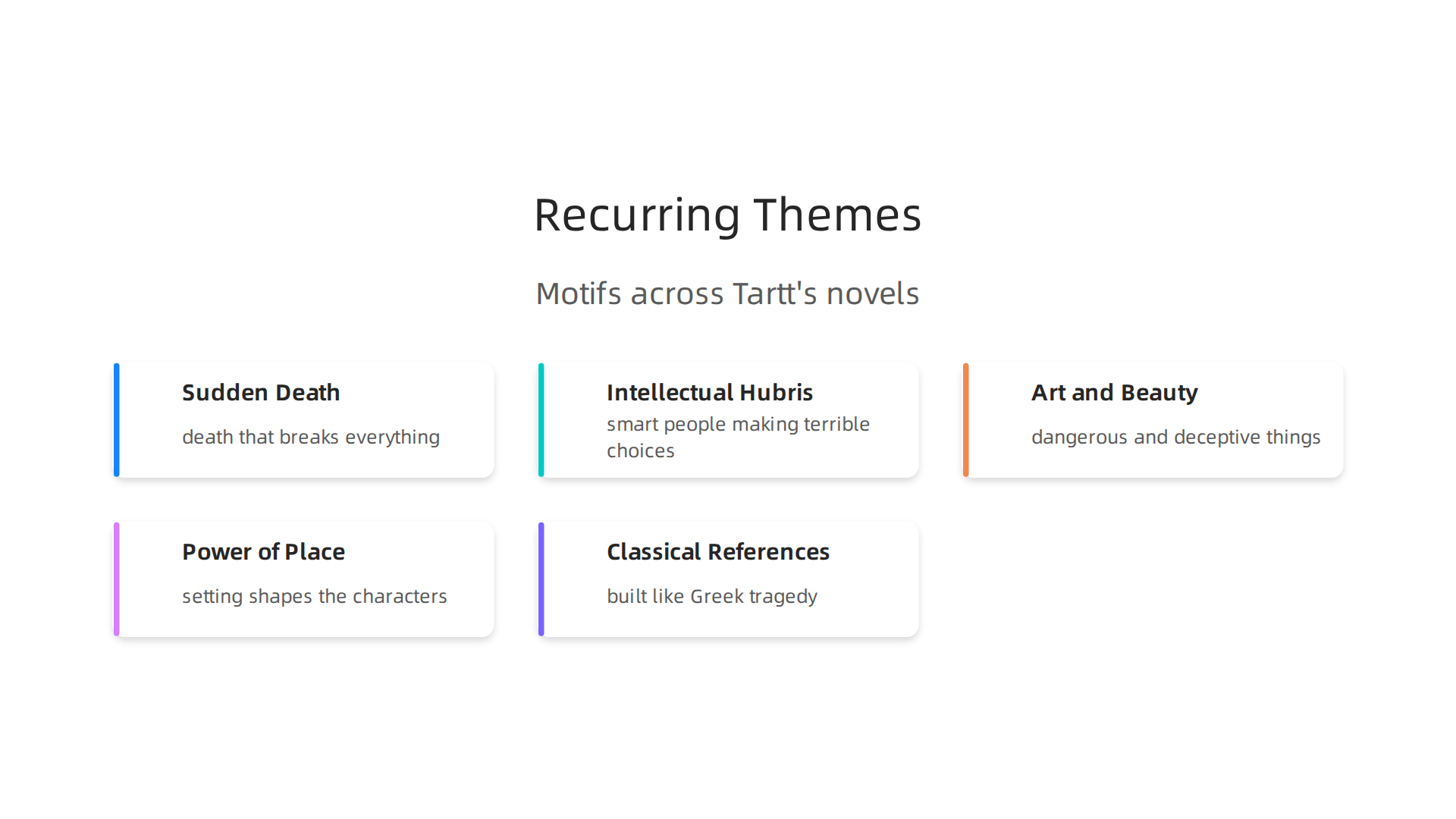
The themes that show up in The Secret History appear again in The Little Friend and The Goldfinch.
Think of them as variations on a single haunting song.
Sudden Death and Its Aftermath
Every Tartt novel starts with a death that breaks everything. In The Secret History, a group of college students kills one of their own. In The Little Friend, a young boy is found hanging in the backyard. In The Goldfinch, Theo’s mother dies in a terrorist attack.
The characters do not just grieve. They become stuck. One review of The Secret History on Wordcrafters points out that "another theme throughout The Secret History is the desire to escape oneself." All of Tartt’s characters are running from who they become after death touches them. They try to outrun the emptiness. They never can.
Intellectual Hubris and the Price of Knowledge
Tartt loves to show smart people making terrible choices. In The Secret History, the students think their classical studies make them better than everyone else. According to a LitCharts breakdown of the novel, key themes include "the human capacity for violence" and how "intellectual pursuits and reasonability" clash with real life. That clash is the whole engine of the book.
The same pride shows up in The Little Friend. Harriet thinks she can solve a murder because she is clever and determined. She is wrong. And in The Goldfinch, Theo keeps telling himself he will return the painting someday. He never does.
This is why Tartt’s work feels so honest. Her characters are not heroes. They are people who know better and still fail.
Art and Beauty as Dangerous Things
Every Tartt novel circles around art. In The Secret History, the beautiful language of Greek tragedy disguises a dark heart. As one review on The Gothic Bookworm puts it, the novel is a "hauntingly beautiful and mystical tale." That beauty is part of the trap.
In The Goldfinch, the painting is literally stolen. It represents everything Theo cannot let go of. And in The Little Friend, the beauty of the Mississippi summer contrasts with the ugliness of what happened there. A reader on Goodreads called the book "tasty, heavy, Southern-saturated wordy goodness." That Southern gothic atmosphere is itself a kind of art.
Tartt seems to ask: Can something beautiful ever be truly good? Or does it always lead us somewhere dark?
The Power of Place
Place matters a lot in Tartt’s world. The cold Vermont campus in The Secret History. The sticky Mississippi heat in The Little Friend. The glittering emptiness of Las Vegas in The Goldfinch.
Each setting shapes the characters. You cannot imagine the Hampden students anywhere but that closed-off college. You cannot picture Harriet without the South wrapping around her. The places are not just backgrounds. They are characters in their own right.
How the Themes Evolve
Here is the cool part. The themes grow as Tartt’s career goes on. In The Secret History, the death is caused by the characters themselves. It is a choice. By The Little Friend, the death is a mystery. Harriet is trying to understand something she did not witness. By The Goldfinch, the death is random and senseless. Theo did nothing wrong. He was just in the wrong place.
Tartt’s view of the world gets more tragic with each book. The first novel is about guilt. The second is about the search for meaning. The third is about accepting chaos.
If you love stories that respect their readers enough to ask hard questions, Tartt is for you. And if you enjoy this kind of deep literary analysis, you might also appreciate the timeless storytelling in classics like those covered in our guide to the timeless appeal of Frances Hodgson Burnett books.
Classical References Everywhere
Tartt studied classics in college. It shows. The Secret History is built like a Greek tragedy. According to a critical review on Teen Book Recommendations, the novel "fits with the themes of a Greek Tragedy: the idea of conflict, sacrifice, retribution, knowledge, fate." The characters have hamartia, that fatal flaw that brings them down.
The Goldfinch takes its name from a real 17th-century painting. The novel plays with ideas of fate and chance that go back to ancient philosophy. And The Little Friend borrows its structure from Southern gothic literature, which itself owes a debt to classical storytelling.
These references are not showy. They are the bones holding the stories up.
What It All Means
Tartt writes about the same things because she is trying to answer one big question. What do we do when life breaks us?
Her answer is never simple. But that is why we keep reading. She does not give us easy comfort. She gives us truth, wrapped in beautiful sentences.
Among mystery novels to read, Tartt’s books stand apart because the mystery is not about who did what. The mystery is about who we become in the aftermath. That is a much harder question to answer.
And for readers who love mysterious novels to read that linger long after the last page, Tartt delivers every single time. Her work has the same weight as a good cormac mccarthy books experience, dense and dark and unforgettable.
Tartt only writes one book per decade. But she makes each one count. The themes connect. The questions stay the same. And the answers keep slipping away, just like they do in real life.
The Mystery of the Slow Process: Why Tartt’s Novels Take Decades
By now you might be wondering something. If Donna Tartt writes the same story over and over, why does each book take ten years?
It is a fair question. And the answer says a lot about what makes her work so powerful.
The Perfectionist’s Method
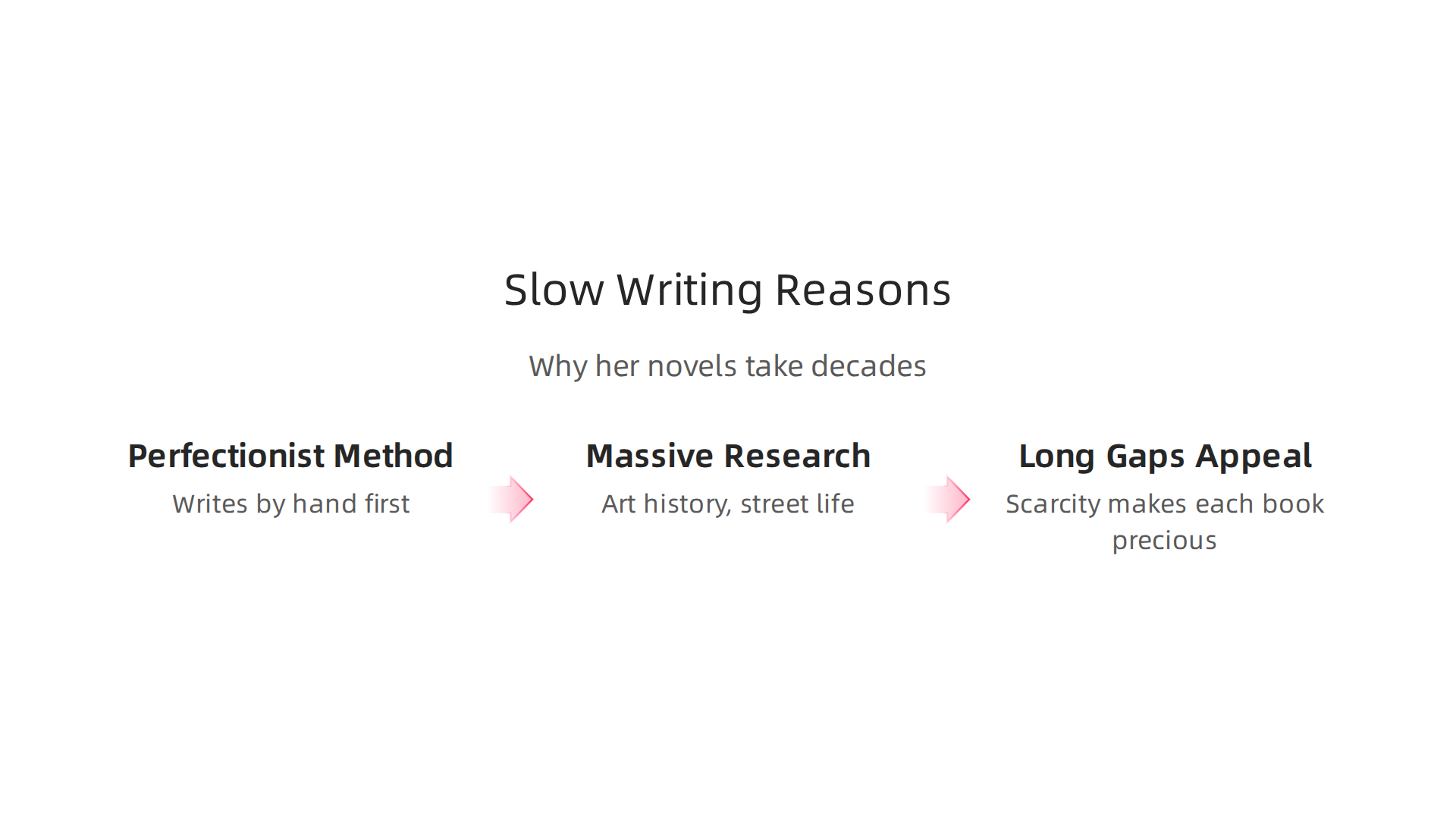
Tartt does not write fast. She writes by hand first, scratching things out and underlining in different colors. That comes from her own description of her process on Language is a Virus. Only after that does she move to a typewriter. Then she revises again.
This is not writer’s block. It is extreme perfectionism. In a 2021 interview with Rivista Studio, Tartt said the writing process is not excruciating for her. She actually loves it. But love does not mean speed. She wants every sentence to carry weight. Every word has to earn its place.
The research for each book is massive too. When she wrote The Goldfinch, she spent much of her time at the New York Public Library in the Allen Room, digging into art history, furniture restoration, and Amsterdam street life. That kind of depth takes years.
How the Long Wait Changes Readers
Here is the strange part. The long gaps between her books have become part of their appeal. When a new Tartt novel arrives, it is an event. Readers clear their schedules. Book clubs plan around it. Critics sharpen their pens.
You do not get that feeling with writers who publish every year. The scarcity makes each book precious. It forces us to pay attention.
Think about other famously slow writers. Harper Lee published only two novels, with 55 years between them. J.D. Salinger stopped publishing altogether after Franny and Zooey. Their readers also treated each book like a treasure. When you wait a decade for a story, you do not skim it. You live in it.
The Tradeoff
Is this pace worth it? For Tartt, clearly yes. Her books are dense, layered, and unforgettable. You cannot rush that. As she explained in a 2017 interview with Dazed Digital, which was covered on Substack, she writes the first draft of her novels quickly. Then comes the hard part: making it right.
If you love reading donna tartt books, the long wait is part of the experience. You are not just getting a story. You are getting a decade of obsession poured into one object.
For readers who enjoy that kind of slow, careful craft, you might also appreciate the rich worldbuilding in other authors. If you are looking for more mysterious novels to read that reward deep attention, check out our guide to the best stephenie meyer books and other authors to read next. Another author who writes with similar density is Cormac McCarthy. His cormac mccarthy books also demand patience and repay it tenfold.
Slow writing creates lasting art. Tartt proves that every ten years.
How to Approach Reading Donna Tartt: A Guide for New and Returning Readers
So you are ready to dive into the world of donna tartt books. Good choice. But where do you start?

And how do you get the most out of her dense, layered stories? Let me walk you through it.
Start with The Secret History
If you have never read Tartt before, begin with her first novel. The Secret History is the most accessible entry point. It introduces her signature themes: privilege, obsession, and the dark side of intellectual pursuit. The story pulls you in fast. You will understand why so many readers become lifelong fans after just one chapter.
The Goldfinch is her Pulitzer Prize winning novel. It is longer and more sprawling. Save it for after you have built some trust with her style. The Little Friend is the most challenging of the three. It has a slower pace and a more ambiguous ending. New readers sometimes bounce off it. Start with The Secret History first. You will thank yourself later.
Tips for Engaging with Dense Prose
Tartt writes thick books. Do not try to speed read them. Give yourself time.
One trick that helps: keep a character map. Tartt introduces many people, and some of them vanish for chapters before coming back. Jot down who is who on a sticky note or in your phone. It saves you from flipping back two hundred pages to remember a name.
Read in long sessions when you can. Tartt’s power comes from immersion. A ten minute subway ride will not do her justice. Find a quiet afternoon and let the world of the book take over.
Resources for Deeper Exploration
If you finish a Tartt novel and want to talk about it, you have great options. Book clubs love her work.

You can find discussion questions for The Goldfinch that dig into themes of grief, art, and survival. There are also great discussion guides for The Secret History that explore morality and consequence. The Little Friend has thoughtful reading group guides too.
For a more personal touch, check out the Q&A with Donna Tartt from The Queen’s Reading Room. She answers reader questions directly. It gives you a glimpse into her mind and her craft.
If you enjoy the intensity of Tartt’s storytelling, you might also like other authors who write with similar depth. For more recommendations, explore our guide to the best stepheme meyer books and other authors to read next. Both authors create worlds you do not want to leave.
Reading Tartt is not a race. It is a slow, rewarding experience. Take your time. The books will wait for you.
Summary
This article is a reader-friendly guide to Donna Tartt and her three major novels—The Secret History (1992), The Little Friend (2002), and The Goldfinch (2013)—explaining what makes her work distinctive and why each release becomes a literary event. It outlines Tartt’s background, classical training, and reclusive, perfectionist process that produces dense, immersive books with long gaps between them. The piece summarizes each novel’s plot, tone, and reception, compares recurring themes like sudden death, intellectual hubris, art and beauty, and the power of place, and shows how those themes evolve across her career. It also offers practical advice on where to start, how to read her dense prose, and resources for deeper discussion. By the end, readers will know which Tartt novel best fits their tastes, why her novels feel so lasting, and how to approach them for maximum reward.