
Introduction: Why Journal Book Reviews Are Your Secret Weapon Against Sci-Fi Overload
You love science fiction. That‘s probably why you‘re here. But let me guess: you also feel a little lost sometimes.
Every week, dozens of new sci-fi books hit the shelves. Some are great. Many are not. And with so many choices, it’s easy to waste time on stories that just don‘t click.

You‘re not alone in this. Information overload is at an all-time high. Surveys show that 83% of workers feel overwhelmed by the sheer volume of data coming at them every day. Readers feel this pressure too. According to a 2026 Reader Survey, more than 30% of readers finish over 100 books per year. That’s nearly two books every week. With that many choices, picking the right book can start to feel like work.
That’s where journal book reviews come in.
A book review is more than just a rating or a one-line comment. It‘s a personal record of what you thought, felt, and learned from a story. When you write journal book reviews, you build a filter that cuts through the noise. Instead of trusting a random algorithm or a stranger’s star rating, you trust your own past experience.
Think of it this way: every time you jot down a quick book review after finishing a novel, you create a small data point. Over time, these points form a pattern. You start to see what you really love. Maybe you prefer fast-paced space operas over slow-burn dystopias. Or maybe you realize you actually enjoy comic sci-fi more than you expected.
This method works because it’s personal. It respects your taste and your time. And it‘s easy to start.
You don’t need a fancy system. Just a notebook, a note on your phone, or even a simple document. The key is consistency. Write two or three sentences right after you finish a book. That‘s it.
If you want to dive deeper into finding your next great read, check out our guide on strategies to find science fiction books on Kindle. It pairs perfectly with the journaling habit.
And if you’re in the mood for something that blends big ideas with a light touch, consider a story that doesn‘t take itself too seriously. Add The Ridiculous to Your List — it’s an SF comedy built for fans of wit, chaos, and insight.
Let’s build a reading habit you can trust.
What Are Journal Book Reviews and Why They Matter
So what exactly is a journal book review?
A book review is a description and analysis of a book that goes beyond a simple star rating. It looks at content, style, and meaning. When you keep a reading journal, you turn that process into a personal habit. Instead of writing for an audience, you write for yourself.
Journal book reviews are short, honest reflections you record after finishing a book. They can be a few sentences or a few paragraphs. The point is to capture what you thought, felt, and learned while reading. Think of them as your own private archive of reading memories.

According to the University of Southern California library guide, a book review includes critical analysis and evaluation. When you do this in your journal, you don’t need to follow academic rules. You just need to be real.
Why journal book reviews matter for sci-fi readers
Science fiction is different from other genres. It builds entire worlds, plays with physics, and asks big questions about the future. A quick book review helps you remember those details long after you close the book.
Here’s why journaling works so well:
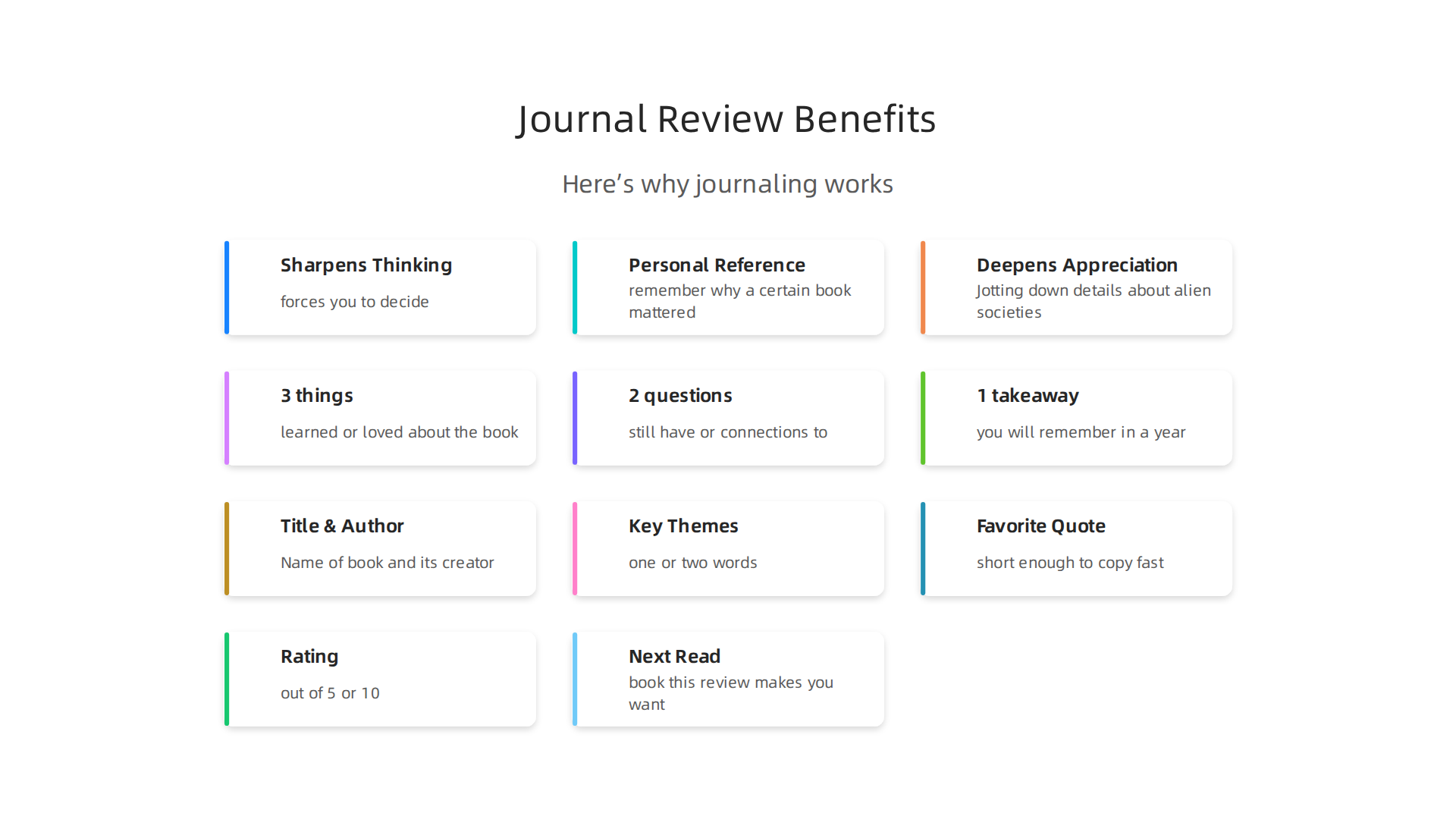
- It sharpens your thinking. Writing about themes, characters, and plot forces you to decide what you actually think. You move from "I liked it" to "I liked how the author used time travel to explore regret."
- It creates a personal reference guide. Months or years later, you can flip back and remember why a certain book mattered. This is especially helpful when you want to recommend a book to a friend or pick a similar read.
- It deepens your appreciation of worldbuilding. Science fiction relies on complex settings. Jotting down details about alien societies, futuristic tech, or alternate timelines helps you notice patterns across books.
If you enjoy stories that respect real science and push your imagination, journaling is a natural companion. For example, when reading hard sci-fi novels that respect real physics and tell gripping stories, a quick entry about the scientific concepts can make the experience stick.
It’s simpler than you think
You don’t need a fancy system. A notebook, a note on your phone, or even a shared document works. The key is consistency. Write your review right after finishing the book, while the feelings are fresh.
Your journal book reviews don’t have to be long. In fact, quick book reviews are often more useful because they capture your first honest reaction. Over time, these small notes build into a map of your reading life. That map will guide you toward better book choices and away from wasted time.
In the next section, we’ll look at a simple method to start your journaling habit without overthinking it.
How Journal Book Reviews Combat Information Overload
You probably know the feeling. You open your favorite book app or browse online, and suddenly you are drowning in options. Thousands of sci-fi titles, endless new releases, and everyone saying their pick is "unmissable." Information overload is real, and it can freeze your reading decisions. But here is the thing: your own journal book reviews can cut through that noise better than any algorithm.
Quality over quantity
When you limit yourself to a short journal entry, you force yourself to focus on what really matters. Instead of trying to remember every plot point or character, you ask, "What was the central idea? How does it relate to other books?" This simple filter helps you ignore the fluff and capture the essence. Over time, you train your brain to spot meaningful stories faster.
A 2024 study on habit formation showed that repeating a behavior consistently changes how your brain processes information (PMC). The more you write quick book reviews, the easier it becomes to separate the signal from the noise.
Journal prompts sharpen your attention
You do not need to stare at a blank page. A simple structure like the 3 2 1 strategy works perfectly for journal book reviews.
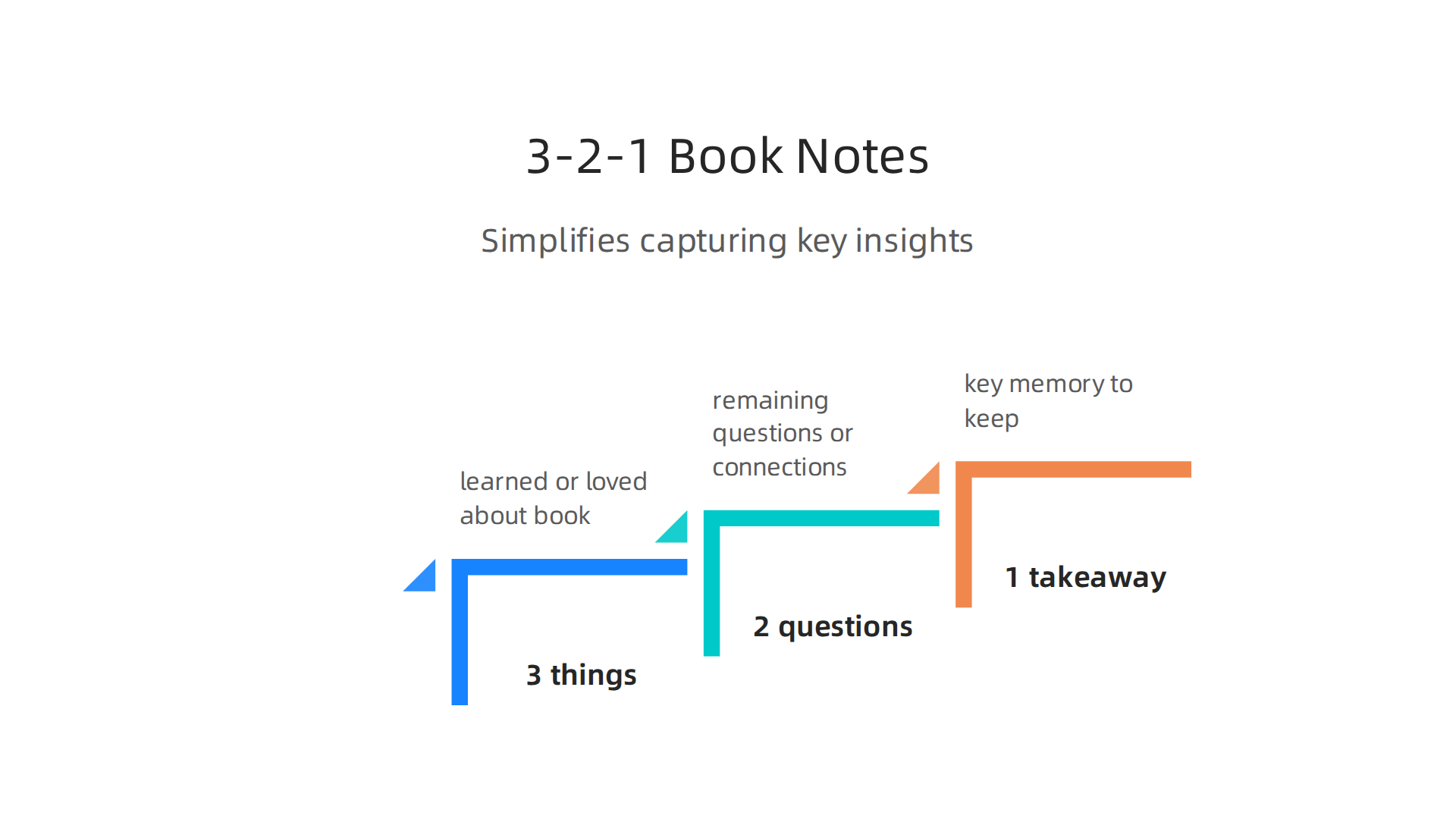
The teachthought.com article explains how this method helps organize thoughts quickly. Here is a version built for reading:
- 3 things you learned or loved about the book
- 2 questions you still have or connections to other books
- 1 key takeaway you will remember in a year
This prompt works for any book, whether you are reflecting on a classic like Sense and Sensibility or a modern page-turner like We Were Liars. It keeps your mind engaged without overwhelming you.
Reading itself improves cognitive function, including memory and concentration (NU.edu). Pair reading with a short journal entry, and you double the benefit.
Your journal becomes your own recommendation engine
After a year of journal book reviews, you will have a personalized guide. Forget generic lists. Your past entries will tell you exactly which authors, themes, and plot styles you love. When you want your next read, just flip through your notes.
If you enjoy discovering new books without the overwhelm, try using our 7 strategies to find science fiction books on Kindle alongside your journal. You will develop a system that works for you.
Ready to start?
The best time to begin is now. Grab a notebook or open a note on your phone. Write your first quick book review today. And if you want a fun, fast read to practice with, consider this SF comedy built for fans of wit, chaos, and insight. Add The Ridiculous to Your List. Your journal will thank you.
Building Your Personal Sci-Fi Reading Journal
Now that you know how journal book reviews can cut through the noise, let’s set up a system built just for science fiction. You already have your notebook or note app ready. Here is how to make it work without overcomplicating things.
Start simple
You do not need a fancy template. Just create a few fields for each entry:
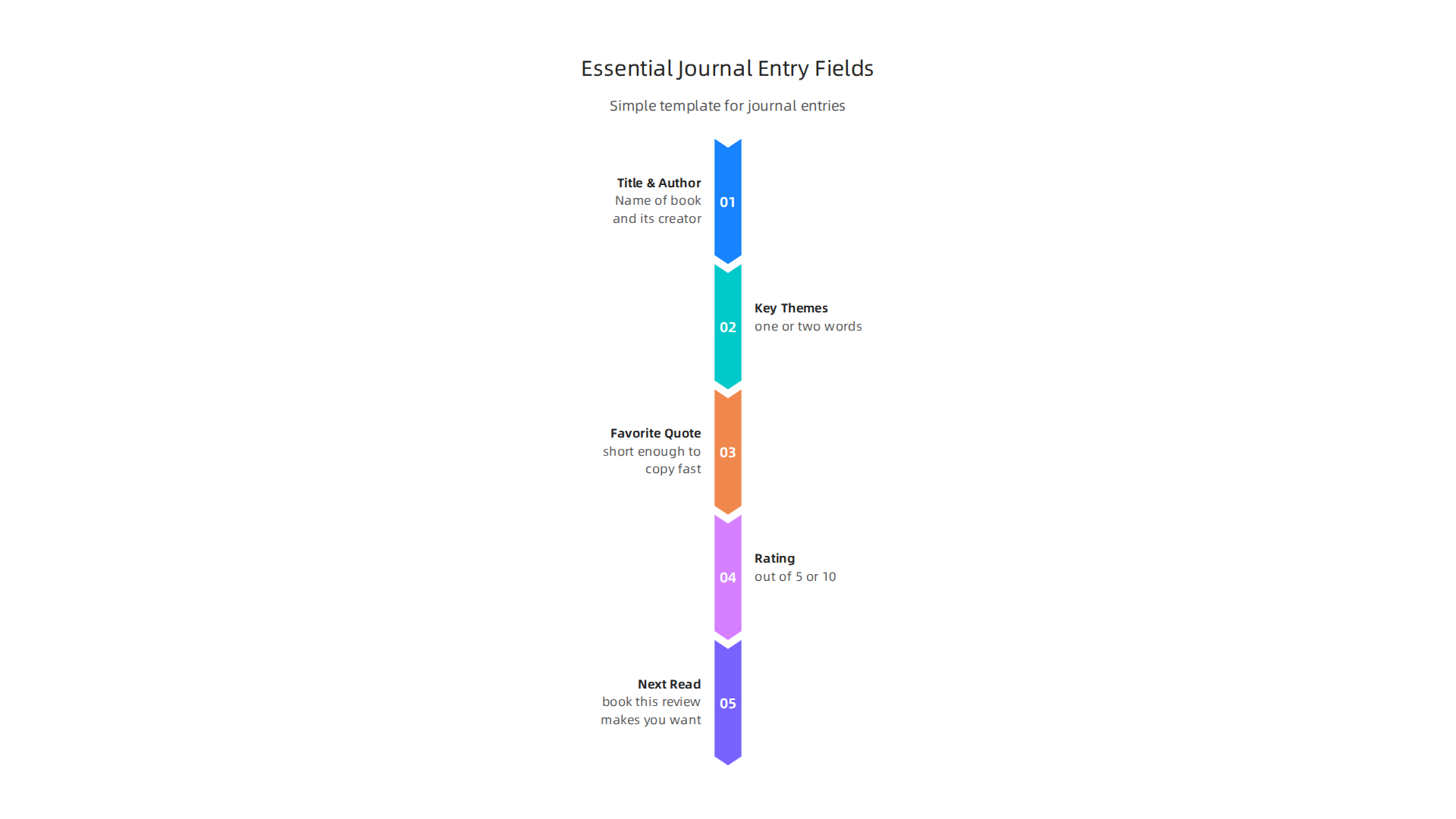
- Title and Author
- Key Themes (use one or two words, like "artificial intelligence" or "first contact")
- Favorite Quote (short enough to copy fast)
- Rating (out of 5 or 10, whatever feels right)
- Next Read (one book this review makes you want to pick up next)
That is it. Five fields. You can write the whole thing in under five minutes. This keeps your quick book reviews consistent and easy to scan later.
Develop a consistent shorthand
Nobody wants to read a full essay for every book you finish. Instead, limit yourself to 3 to 5 bullet points max. This forces you to capture only what matters. For example:
- Loved the worldbuilding in this space opera
- The pacing dragged in the middle
- Reminded me of Ursula K. Le Guin
- Would recommend to fans of hard sci-fi
Over time, this shorthand helps you spot patterns in your own taste. You will start noticing that you prefer cyberpunk over time travel stories, or that you always give high ratings to books with strong female leads.
Add a sci-fi subgenre tag
Here is the secret weapon for your journal: a tag field for subgenres. Science fiction is huge. It includes space opera, cyberpunk, time travel, dystopia, alien invasion, and even cozy sci-fi. In 2026, cozy sci-fi is growing fast with gentle, character-driven stories set in futuristic settings (BooksShelf). Adding a tag like "cozy" or "space opera" to each entry lets you sort your own reading history later.
After a year, you can flip through your journal and see that you rated three out of four cyberpunk novels 5 stars. That tells you exactly what to search for next time you are at the bookstore. No more guessing.
If you love heavy science that respects real physics, check out these hard sci-fi novels that respect real physics and tell gripping stories. Tagging them in your journal will help you find similar titles fast.
Ready to build your journal?
Grab a notebook or open a simple document. Write your first entry today using the fields above. And if you want a fun, quick read to practice with, try this SF comedy built for fans of wit and chaos. Add The Ridiculous to Your List. Your personal recommendation engine starts with one entry.
Quick Review Formats for Busy Readers
Life moves fast in 2026. Between work, family, and the pile of unread books on your nightstand, who has time to write full essays about every story you finish?

The good news is that you do not need paragraphs to capture what matters. You just need the right format.
Let me share two frameworks that turn journal book reviews into a two minute habit. They are fast, focused, and built for the way you actually think about science fiction.
The 3-2-1 method
This format comes from education circles, where it helps students structure their thoughts quickly (The Teacher Toolkit). It works just as well for quick book reviews. Here is how it breaks down:
- 3 things you loved about the book. Maybe the worldbuilding blew you away, or the dialogue felt real. List three specific wins.
- 2 things you questioned. These are small gripes or confusing moments. The pacing dragged in chapter five. A character made a choice that felt off. Nothing too harsh, just honest.
- 1 overall takeaway. One sentence that sums up the whole reading experience. Think of it as the line you would tell a friend at a coffee shop.
That is it. Six points total. You can finish in under three minutes, and the structure forces you to think clearly. Look how effortlessly you can adapt the 3 2 1 method to any genre. Whether you just finished a dense space opera or a quick novella, this format keeps your journal book reviews consistent without feeling like homework.
The sci-fi lens format
Science fiction asks different questions than other genres. So your review should too. This format is made specifically for SF readers who want to track what actually matters in their genre.
Assess each book on four factors:
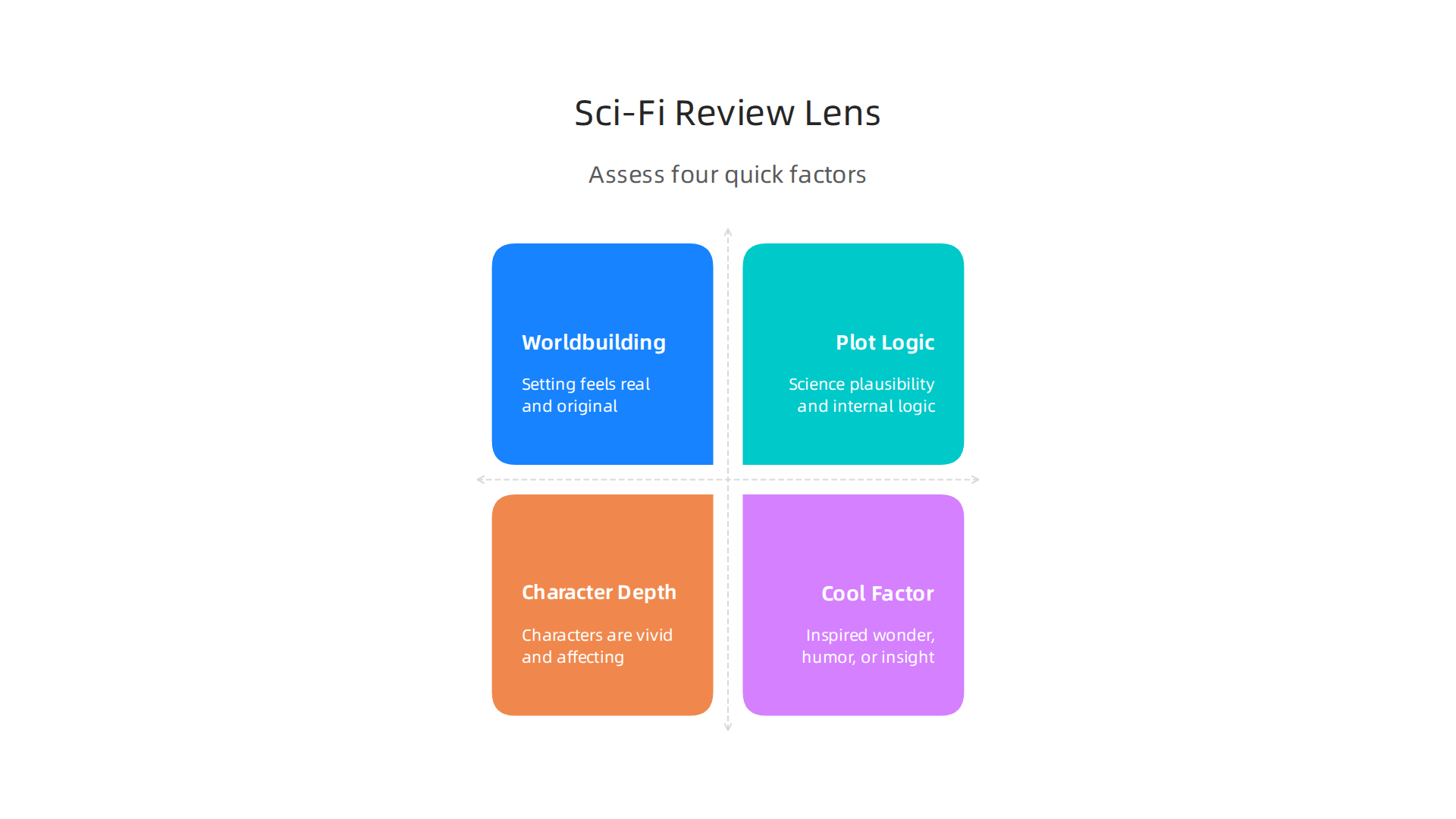
- Worldbuilding. Does the setting feel real and original? Or does it borrow too much from familiar tropes?
- Plot logic. Does the science hold up? Even soft SF needs internal consistency.
- Character depth. Are the characters people you care about, or just vehicles for ideas?
- Cool factor. Be honest. Some books earn high marks simply because they made you smile or think differently.
Rate each factor out of 5, then add a short note. After a few entries, you will notice patterns. Maybe you always give high scores for worldbuilding but low scores for character depth. That tells you exactly what kind of reader you are. Want to dig deeper into stories that prioritize plot logic and science? Check out these hard sci-fi novels that respect real physics and tell gripping stories. Tagging them in your journal makes future recommendations effortless.
Both formats take two to three minutes per entry. That is fast enough to stick with even when you are busy. And over time, those short entries build a personal library of taste that guides every reading decision you make.
Want to practice right now?
Grab a book you finished recently. Any book. Write a 3-2-1 entry or a sci-fi lens entry in under five minutes. See how it feels. And if you want a fun, quick read to test your new skills, try a story built for wit and perspective. Check out a series that pairs cosmic absurdity with meaning. Your personal recommendation engine starts with one fast entry today.
Where to Find Trusted Journal Book Reviews and Communities
You have your quick review formats ready. You know how to capture your thoughts in two minutes flat. But reading great reviews from other people can also teach you a lot. A well written book review describes the content, analyzes the style, and judges the merit of a book. That is the definition straight from the experts at Wikipedia.
The trick is knowing where to find thoughtful reviews instead of clickbait or one line opinions. Here is where the best conversations happen in 2026.
Established outlets that go deep
Some sources have been doing this for decades. They are worth your time because they hire professional critics and passionate fans who know the genre.
- Dedicated sci-fi magazines. Think of places like Clarkesworld. These publications run reviews that explore worldbuilding, plot logic, and character depth. They treat a book review as a serious evaluation of quality and meaning, similar to what you would find in academic journals.
- Academic journals. Publications like Foundation offer peer reviewed analysis. These are thorough, critical evaluations that help you understand why a book matters. They are perfect when you want to dig deeper into a story’s themes.
- Curated blogs. Some independent reviewers have built loyal audiences by sharing honest, detailed personal insights. They cross reference other books and acknowledge their own biases. That honesty makes their recommendations more useful than generic Amazon blurbs.
If you want to see what top critics are reading this year, check out the best sci-fi and fantasy books of 2026. It is a great starting point for your journal book reviews.
Peer communities where real talk happens
Sometimes the best recommendation comes from a stranger on the internet who loves the same weird subgenre you do.

- Subreddits. r/printSF is a goldmine for science fiction fans. Readers post detailed breakdowns and argue respectfully about what makes a book great.
- Goodreads groups. The discussion forums there let you find people with similar tastes. You can join a group focused on space opera or dystopian fiction and trade recommendations instantly.
- Discord servers. These are more casual and fast moving. You can ask for a recommendation and get thoughtful replies in minutes.
According to the 2026 Reader Survey, more than 30% of readers now consume over 100 books per year. That means there are lots of experienced readers sharing their thoughts in these spaces.
How to spot a thoughtful review
Not every review is worth your time. Look for these signals of quality.
- Detailed personal insights. A good reviewer explains why a scene worked or failed.
- Cross references. They compare the book to other similar titles. That shows they know the genre.
- Acknowledgment of bias. Everyone has preferences. Honest reviewers admit theirs.
For example, an academic book review provides a critical service by evaluating new works and promoting scholarship. You can apply that same standard to any review you read online.
Ready to discover your next great read
Finding trusted reviews is the first step. The next step is finding a book that matches your taste. If you love smart, funny science fiction that challenges your thinking, you will enjoy a story built for wit and absurd action. Read Smart Funny SF and see how a great review can lead you to a memorable reading experience.
Summary
This article explains how short, personal journal book reviews can help science fiction readers cut through the overwhelm of new releases and make smarter reading choices. It describes what a journal book review is, why it matters for tracking worldbuilding and themes, and how writing brief entries sharpens your taste over time. You’ll learn simple, repeatable formats — like the 3‑2‑1 method and a sci‑fi lens that rates worldbuilding, plot logic, character depth, and cool factor — plus a minimalist entry template to keep the habit fast. The piece shows how tags and shorthand reveal long‑term patterns in your preferences, turning your notes into a private recommendation engine. It also points you toward trusted review outlets and communities where deeper discussion happens. Overall, the guide focuses on practical, two‑ to three‑minute routines that fit busy schedules and improve every future book choice.